




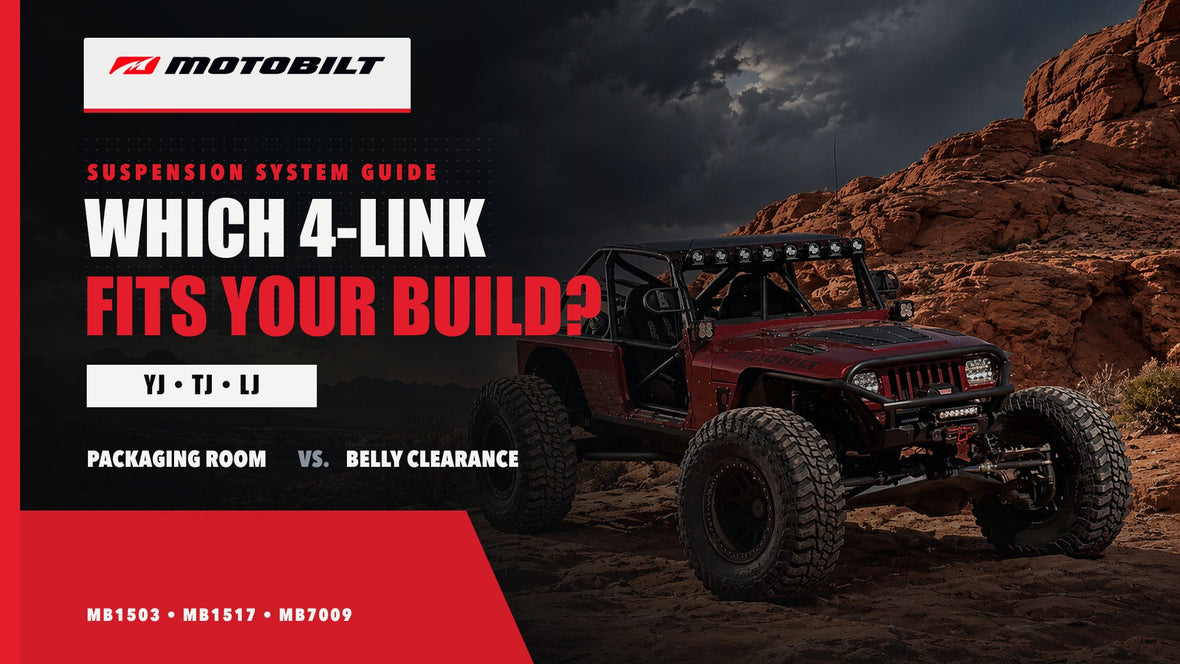
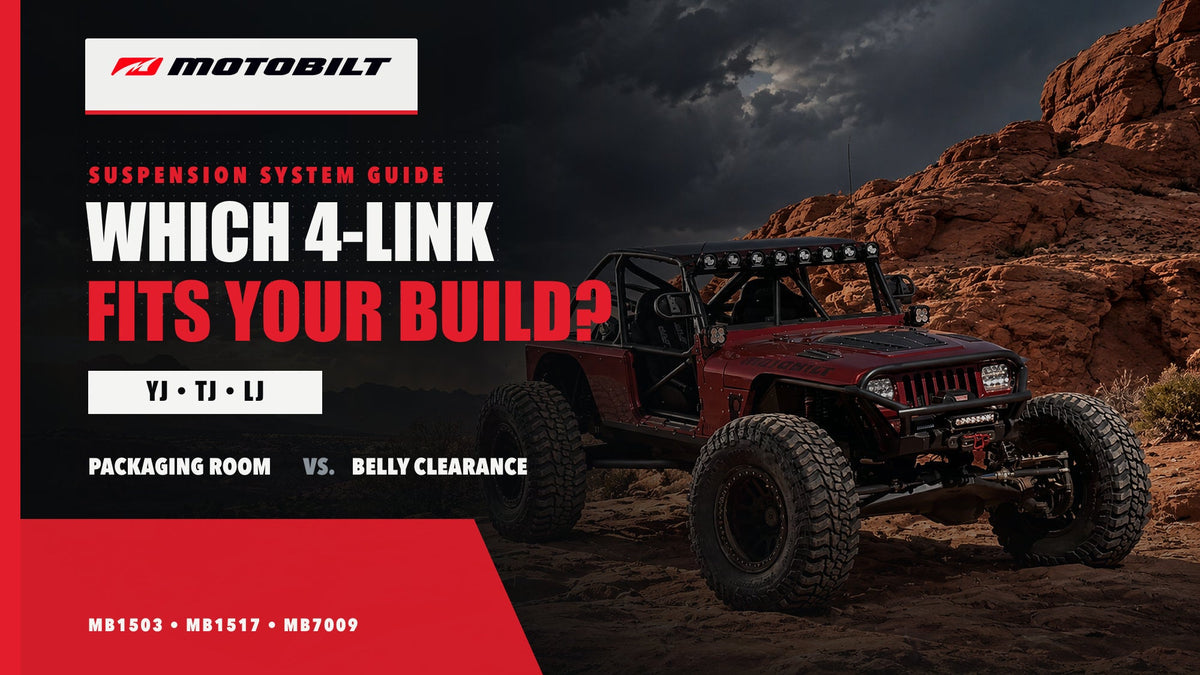
Which Motobilt 4-Link Fits Your Jeep YJ, TJ or LJ?
Motobilt suspension system guide
Two systems. Two different build priorities.
Start with the complete Jeep. MB1503 and MB1517 prioritize room around the drivetrain and exhaust. MB7009 packages the center more tightly to create a narrower, boat-sided belly on the trail.
MB1503 / MB1517
More room to package
Transmission, transfer case, exhaust and driveshafts
MB7009
More clearance at the edges
Narrower boat-sided skid and smaller contact footprint
You are not choosing between an old Motobilt suspension system and a new one. You are choosing between two current ways to establish the frame-side foundation of a linked Jeep YJ, TJ or LJ.
For YJ builders, the choices are MB1503 and MB7009. For TJ and LJ builders, the choices are MB1517 and MB7009. The right answer depends on wheelbase, steering, axle choice, drivetrain packaging and how much of the chassis you plan to rebuild.
The short answer
Choose MB1503 for a YJ or MB1517 for a TJ/LJ when you want a platform-specific, fully welded center mount and skid assembly designed around a 104 to 118 inch wheelbase.
Choose MB7009 for a YJ, TJ or LJ when you want an integrated double triangulated system for a low-slung build using one-ton axles and 40 inch or larger tires.
Important: These are fabrication systems, not bolt-on lift kits. Both routes require a complete vehicle plan, careful cycling, cutting and welding.
First, what are these systems?
Both product families establish the frame-side link mounts and protect the drivetrain with a skid. The links run from those frame-side mounts to brackets or a truss on the axle. Neither system decides every dimension for you, and neither includes the entire suspension.
New to linked suspension?
A 3-link uses two lower links, one upper link and a track bar up front. A true triangulated 4-link uses link angle to control side-to-side axle movement and does not use a track bar.
Experienced builder?
Start with wheelbase, vertical separation, steering, axle-side separation, tire clearance, driveshaft path and full-bump packaging. The frame-side system should support those decisions.
MB1503 and MB1517: a known center-section starting point
MB1503 and MB1517 use the same basic build philosophy with platform-specific fitment. MB1503 fits the Jeep YJ. MB1517 fits the Jeep TJ and LJ. The assemblies locate from the Jeep's factory skid plate holes and are then welded to the frame.


Why this architecture still makes sense
The MB1503 and MB1517 were released before MB7009, but release date does not define capability. They remain useful because they give a fabricator a strong, known starting point without requiring every frame-side mount to be designed from loose tabs.
- Designed around a 104 to 118 inch wheelbase
- Rear 4-link with a choice of front 3-link or front 4-link
- Factory skid holes provide the initial locating reference
- Main mount bodies and skid are built from 1/4 inch steel
- Secondary boxing plates and internal gussets use 3/16 inch steel
- The body can remain on the Jeep during installation

MB7009: an integrated double triangulated foundation
MB7009 starts with a different goal. It establishes the frame-side mounting points, front and rear crossmembers, removable skid and tubular bracing as one coordinated package for a double triangulated layout. It fits YJ, TJ and LJ frames and integrates with Motobilt front-half, back-half and center-frame systems.

At the frame, MB7009 provides 7-9/16 inches of front link vertical separation and 5-3/16 inches at the rear. The link mounts use 1/4 inch steel, 5/8 inch holes and a 2-5/8 inch inside width. Motobilt recommends 1.25 inch heim joints.
The mounting placement creates room for straight upper and lower links while packaging one-ton axles, oil pans, aftermarket engines, transfer cases and driveshafts. Final wheelbase is set by the builder through link length and axle placement instead of a published fixed range.
Service access is part of the design
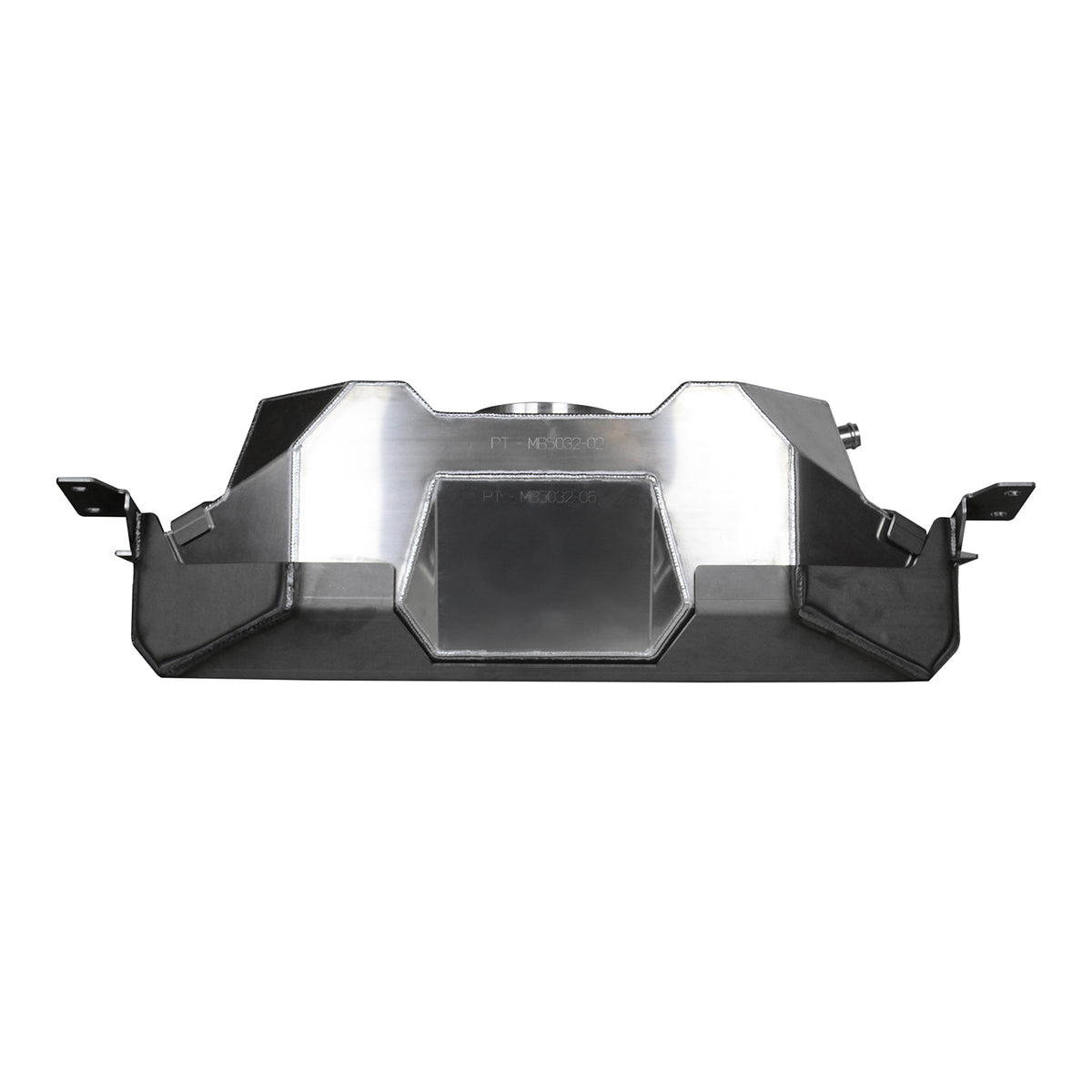
The one-piece skid uses countersunk fasteners for a smooth bottom. The front transmission crossmember and X bracing can be removed independently for drivetrain access.
Temporary bolt-in brackets hold the front lower links when the crossmember is removed, so the Jeep can still be moved around the shop during service.

Side-by-side comparison
| Decision point | MB1503 / MB1517 | MB7009 |
|---|---|---|
| Vehicle | MB1503 for YJ; MB1517 for TJ and LJ | YJ, TJ and LJ |
| Architecture | Platform-specific center mount and skid assembly | Integrated double triangulated system with crossmembers, bracing and skid |
| Wheelbase | 104 to 118 inches | Set by link length and axle placement |
| Front layout | 3-link with track bar or true 4-link | Double triangulated 4-link; convert to 3-link with track bar when retaining a steering box |
| Steering | Steering box or hydraulic assist commonly pairs with the front 3-link; full hydraulic permits a true front 4-link | Full hydraulic for a true front 4-link; steering box requires one upper link removed and a track bar added |
| Skid and service | Included skid; suggested MB3077 transmission crossmember sold separately | Removable smooth-bottom skid, removable crossmember and X bracing, temporary service brackets |
| Drivetrain packaging | Larger, more open area around the transmission, transfer case, exhaust and driveshafts | Tighter center section that requires more planning around drivetrain, exhaust and driveshaft clearance |
| Trail contact footprint | More packaging room inside the center section | Narrower, boat-sided skid with angled edges and a smaller exposed footprint |
| Best fit | A known center assembly, defined wheelbase range and front-layout flexibility | A low-center-of-gravity, one-ton, 40 inch-plus Jeep or larger chassis build |
Drivetrain packaging versus skid clearance
Another important difference between the two systems is the amount of space available underneath the Jeep for drivetrain and exhaust packaging.
More packaging room
MB1503 and MB1517
The larger, more open center area can make it easier to package the transmission, transfer case, exhaust, driveshafts and other components. That flexibility is especially useful with drivetrain swaps and custom configurations.
Smaller trail footprint
MB7009
The center section packages components more tightly, so exhaust routing, drivetrain position and driveshaft clearance need more planning. In return, the boat-sided skid narrows the belly's exposed footprint.
The angled sides of the MB7009 skid reduce the width of the surface that can contact rocks and obstacles while creating additional clearance toward the edges of the chassis. That is the tradeoff: MB1503 and MB1517 provide more room for drivetrain and exhaust packaging, while MB7009 gives up some packaging room for a narrower, boat-sided belly with a smaller contact footprint on the trail.
Neither approach is automatically better. Decide whether packaging flexibility or underbody clearance is the higher priority for the complete build.
The belly-height question
One of the first questions builders ask about MB7009 is why the skid stays at factory height instead of creating a higher flat belly. The answer is geometry and packaging. Raising the frame-side lower link mounts can reduce ground contact, but it can also reduce link separation or push the upper mounts into the tub.
MB7009 keeps the underside at factory skid height by design. That vertical space helps package the links and drivetrain without removing the body or cutting the tub for upper mounts. The skid is narrower and smooth, with countersunk hardware, so it is meant to slide instead of presenting exposed fasteners.
If a higher-than-factory flat belly is the main objective, make that decision before ordering. A custom layout, body lift or additional tub work may be the better path. Moving every mount upward does not automatically improve the complete suspension geometry.

Questions builders keep asking
How much uptravel will I get?
Can I keep a steering box?
Does either system include the complete suspension?
Do I need to remove the body?
Can I use Johnny Joints?
Are MB1503 and MB1517 outdated?
Choose the complete build before the part number
- Confirm the platform. YJ builders can choose MB1503 or MB7009. TJ and LJ builders can choose MB1517 or MB7009.
- Set the target wheelbase. MB1503 and MB1517 are designed for 104 to 118 inches. MB7009 leaves wheelbase to link length and axle placement.
- Choose the steering. A steering box or hydraulic assist normally points to a front 3-link with a track bar. A true front 4-link requires full hydraulic steering.
- Choose the axles and tire size. MB7009 is specifically aimed at one-ton axles and 40 inch or larger tires.
- Place the drivetrain. Check the engine, oil pan, transmission, transfer case, exhaust and front driveshaft at full bump and full droop.
- Decide what matters at the belly. Choose between the more open packaging area of MB1503/MB1517 and the tighter, boat-sided MB7009 footprint, then balance that choice against link separation, tub clearance and service access.
- Cycle everything. Do not final-weld until the suspension and steering clear through their entire range.
Build the system that matches the Jeep
The better system is the one that supports your complete plan. Decide wheelbase, steering, axles, tires, ride height, drivetrain and belly strategy first. Then choose the frame-side foundation.
Need help planning the rest of the chassis? Explore Motobilt parts for the Jeep YJ, Jeep TJ and Jeep LJ.